Parenting with ADHD: 10 practical tips (get kid logistics off one brain)
Parenting with ADHD tips for households: get kid logistics off one brain with shared lists, capture-when-you-notice, aging tasks. Systems, not medical advice.
Parenting already comes with a second job nobody billed: remembering library day, which pants still fit, who has the permission slip, and whether tomorrow is the early pickup. When ADHD is in the mix — a parent, a kid, or both — that second job gets heavier, because holding open loops is expensive.
This is a list of practical household tips, not a diagnosis, not treatment, and not medical advice. We're not claiming you or your child have ADHD, and nothing here replaces professional care if you want it. If attention and working memory are uneven in your home, these are systems and shared tools so the parenting mental load isn't trapped in one person's head.
If you wanted couple-level household architecture (chores, domains, shame-free reminders between partners), that's household systems for ADHD couples. This one is the parenting layer: school, bags, snacks, activities, and the default-parent queue.
1. Capture kid logistics the second you notice
Permission slip in the backpack. Class chat: "bring fruit Friday." Library books due Thursday. The noticing happens in a two-second window. "I'll remember later" is how it becomes a 10pm panic.
Rule: if it matters, it leaves someone's head immediately. Shared list, shared calendar, or a voice note into the household feed — not a sticky intention.
Voice capture helps when you're at pickup with a toddler on your hip. Typing is fine. Timing is the habit. Same move as the rest of the mental load: visibility first.
2. One inbox for the house — including school
School emails, the class group chat, the paper in the lunchbox, the note you shouted from the bathroom. Multiple inboxes guarantee orphans.
Pick one shared household feed for tasks, shopping, and "kid admin this week." Satellite notes (fridge, chat, your Notes app) have to route into it the same day or they die. Whoever owns a domain should be able to open one place and see what's actually open.
3. Own kid domains end to end
"Can you do school this week?" still leaves you as dispatcher. Better: one adult owns school communication this term — reading the emails, knowing non-uniform day, packing the bag standard, chasing the form. Another owns sports gear. Another owns dental and the clinic calendar.
Conception and planning have to move, or you're still the default parent with a deputy. Help is not ownership.
4. Make the start tiny (especially for bags and transitions)
"Get ready for school" is a freeze trigger for an ADHD kid and an ADHD parent. "Shoes by the door" starts. "Library books in the tote" starts. Done can still be complete — start size is separate from done size.
Write the first physical move on the list, not the novel. The rest of the sequence can live as a visible checklist on the wall once the start exists.
5. Let aging and alarms nag so you don't have to
Nagging a partner about the costume, nagging a kid about the recorder, nagging yourself at 11pm — that's three jobs. Let the system surface stale items: the permission slip that has been sitting, the snack duty that hasn't moved.
You're allowed to want reliability. Externalizing isn't giving up standards. It's refusing to be the household's prosthetic memory and the alarm clock.
6. Put kid restocking on a shared shopping list
Gloves, wipes, the snacks they will actually eat, birthday-party presents, printer paper for the school project announced at 8pm. If only one person notices when the cupboard is empty, that person is still the inventory.
Capture at the moment of noticing. One list, both phones. Write items the other adult can execute ("size 8 school tights, 2-pack") instead of "kids' bits." More on the habit layer: shared shopping list habits for couples.
7. Put cues in the room, not only on the phone
Kids don't live in your task app. A bag hook by the door, a library-book bin, a visual "tomorrow" tray, shoes that have a home — those are working-memory prosthetics for the whole household.
Phone capture is for the adults. Environment is for the morning chaos. Use both. Don't expect a shared list to replace a landing zone.
8. Agree a low-capacity parenting mode in advance
Some weeks executive function tanks — deadlines, illness, sleep debt, whatever else is going on. Shame is a terrible architecture for those weeks.
When calm, agree the minimum viable parenting week: safe food, bags packed enough, school communication not dropped, laundry at underwear-tier. Drop the optional (elaborate lunches, extra activities admin) without a fight. You don't need a diagnosis to need a red week.
9. Change who school actually contacts
If every email, every sick-child call, and every "can you bring spare clothes" texts one number, the system will keep routing through that person. Add the other adult. Share the calendar for real — both receive the invite.
Institutions love a single point of contact. Defaults stick unless you change the routing.
10. Review kid logistics on a short, scheduled check-in
The 9pm "did you see the email about tomorrow" is a terrible meeting. Ten minutes twice a week — what's open, what aged, what domain bounced back — beats surprise audits at bedtime.
Keep the agenda parenting-narrow: school, activities, restocking, appointments. Misses are data for the system, not proof someone doesn't care — that goes for an ADHD parent and an ADHD kid.
Where Carry fits
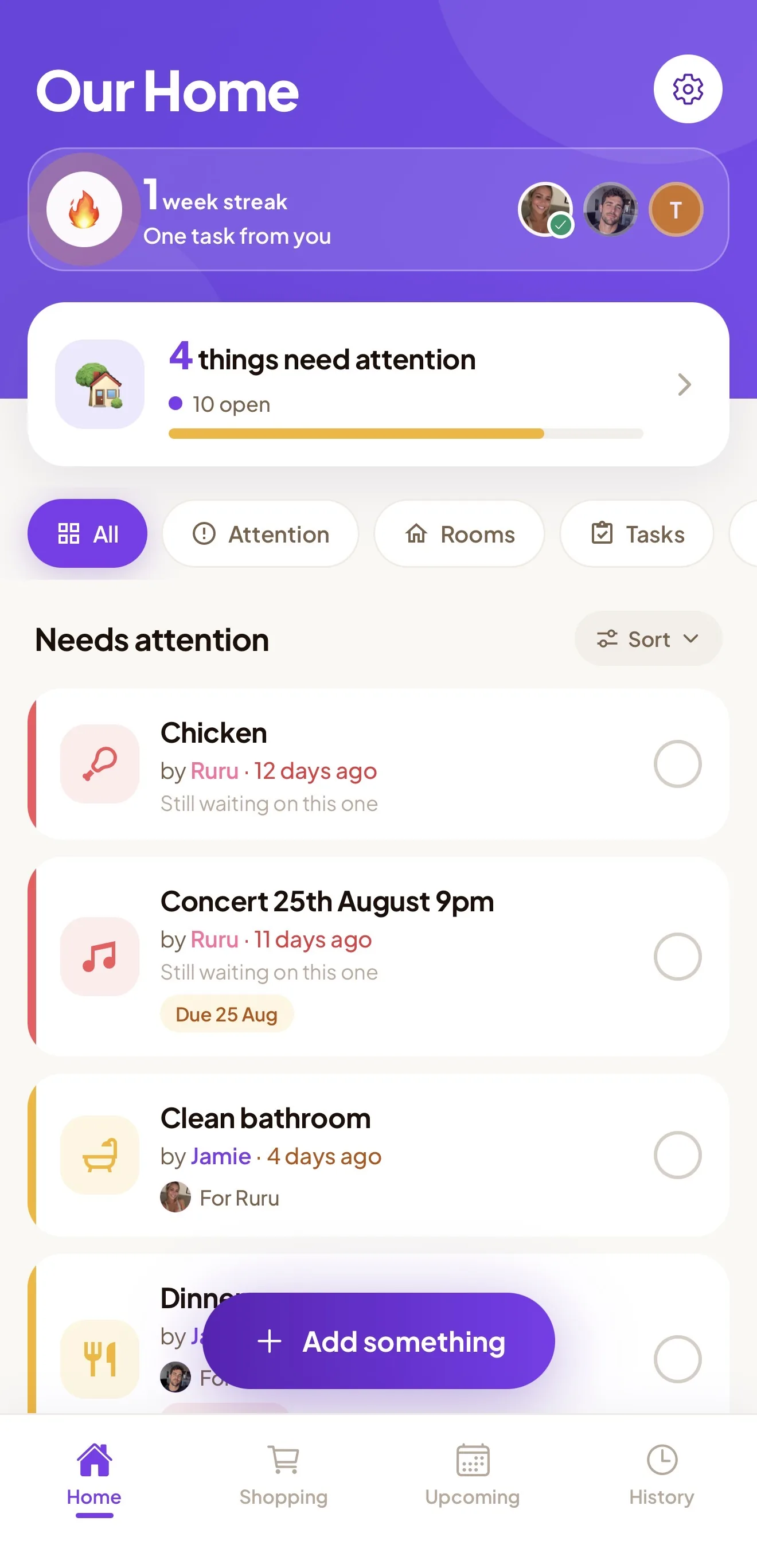
Carry is a shared to-do and mental load app for households: one home feed for tasks, shopping, and events, so kid logistics aren't trapped in the default parent's working memory. Voice capture when an idea would otherwise vanish at pickup. Shopping with aisle grouping. Items that visibly age so outstanding forms and snack duties surface without a nag. A household task app doesn't make you a better parent by magic. It stops parenting from requiring one brain to stay on all day.
Carry is not therapy, not a diagnosis tool, and not a substitute for professional ADHD care. It's a shared list shaped for home life. You can download Carry on the App Store (free to download, 7-day trial on Plus).
If you want a gentler opener than a raw inventory, the Mental Load Score is a few questions — not a clinical score, not a diagnosis — so you can put the load on the table before burnout is the only language you have.
Parenting with ADHD doesn't require becoming a different person by force of will. It requires putting remembering where phones and rooms can hold it — together — so the kid's week isn't stored in one parent's head.